|
|

TO OTHER PAGES: 1 • 2 • 3 • 4 • 5 • 6 • 7 • 8 • 9 • 10 • 11 • 12 • 13 |

|
James R. Murphy
His passion quickly deepened beyond reading. Inspired by Ellery Queen's own habit of collecting first editions, Murphy began assembling a complete collection of Queen first editions himself, guided by Otto Penzler, the legendary proprietor of The Mysterious Bookshop on West 56th Street. He succeeded - no small feat in the pre-internet era.
Murphy long harbored the ambition of writing
a guidebook to the world of Ellery
Queen, a dream partly inspired by
Francis M. Nevins's The result is the work of a lifelong devotee: a reader's guide to the 32 novels written by Ellery Queen about Ellery and Inspector Queen, enriched by Murphy's personal collection of first editions and his decades of intimate familiarity with the Queen canon. The excerpt from the book he offered us below is his attempt to play "the game," in which he proposes to "prove" that the real Ellery Queen, detective, was not present in America during the period in which the events of most of the Period Two novels took place... |


| Spoiler Warning -- To those who may not, as yet, have read the Ellery Queen works mentioned -- there are some minor spoilers contained in this part from the book. While no major spoilers, there are details mentioned from several books that some readers might still consider as such. |
 |
|
HOLLYWOOD HERE WE COME |
||
I chose to begin what is sometimes referred to as Queen’s
“Hollywood period” with The Door Between rather
than with Halfway House, which is traditionally
considered the first novel of Period Two. I did not do this
in order to pick a fight with Francis M. Nevins
 ,
the leading Queen scholar who originally designated the four
Queen periods - I defer to Mr. Nevins
superior knowledge in all things EQ. I could say that I did
it because I find Halfway House to be superior to
the other four Period Two novels, and closer in style to
The Spanish Cape Mystery than to The Door Between.
But the truth is I just happen to love Halfway House
and I couldn’t bear to lump it in with what are probably my
least favorite Queen novels. Even Nevins
says that the transition between Periods One and Two is “a
gradual evolution, not a sudden change of course.” ,
the leading Queen scholar who originally designated the four
Queen periods - I defer to Mr. Nevins
superior knowledge in all things EQ. I could say that I did
it because I find Halfway House to be superior to
the other four Period Two novels, and closer in style to
The Spanish Cape Mystery than to The Door Between.
But the truth is I just happen to love Halfway House
and I couldn’t bear to lump it in with what are probably my
least favorite Queen novels. Even Nevins
says that the transition between Periods One and Two is “a
gradual evolution, not a sudden change of course.”While the aforementioned Mr. Nevins
has quite rationally explained the eventual radical changes
to the character of Ellery Queen during
Period Two in terms of the authors desire for publication in
the “slick” women’s magazines of the day and adaptability to
the silver screen, I have another theory: J.J. McC wasn’t a
total liar, after all. Sometime after Halfway House
and before Calamity Town, Ellery Queen
did travel to Italy (France, as well) and, in fact, had
nothing whatsoever to do with the four cases which appeared
in between! Now, here, of course, I am attempting the play
“the game,” assuming that Ellery was a real person and not a
fictional character, but hear me out as I present the
evidence behind my theory: |
||
| • The first thing J.J. McC tells us, right at the start of the very first Queen novel, is that Ellery, along with the Inspector, Mrs. Ellery Queen, and Ellery Jr., are retired and living in sunny Italy. This is true, but only partially. Ellery is in Italy, but not retired, simply on one of his many documented trips to the continent (see Face to Face and The House of Brass) to gather material for future novels from far-flung police chiefs. Obviously, “Mrs. Ellery Queen” and “Ellery, Jr.” were fabrications designed to discourage overly zealous female fans from attempting to track Ellery down on his European sojourn. Wasn’t it Frederic Dannay himself who said, “No, all statements in The Roman Hat Mystery notwithstanding, Ellery will stay a bachelor….”? * As for the Inspector, he was nowhere near retirement age yet and was back in New York, still on the job. | ||
| • The real detective in the case of The Door Between is clearly Terry Ring; Ellery was simply inserted into the story in order to keep the series alive while he was away. | ||
| • The Devil to Pay is a complete fraud, but an honest one - the author keeps telling us that the main character’s name is Hillary King, not Ellery Queen! Simply another attempt to keep the series alive in Ellery’s absence. For proof that Hillary is not Ellery, one need look no further than the detective’s attempted use of the ancient art of ju-jutsu, and utterance of lines like “Give, sister. We work on the same rag.” | ||
| • The Four of Hearts opens with the line: “It is a well-known fact that anyone exposed to Hollywood longer than six weeks goes suddenly and incurably mad.” The very next line in the text has “Ellery” groping for an open bottle of Scotch with which to drown his sorrows. Madness, and/or drunkenness, can be an excuse for a person behaving completely out of character. But the simpler explanation is that the real Ellery Queen was nowhere near La-La land during the case of the Royles and the Stuarts. | ||
| • The Dragon’s Teeth presents, perhaps, the strongest evidence of the author’s deception, for in it we are basically told that Ellery Queen is not Ellery Queen! He is Beau Rummell, the real detective in the story, who goes around calling himself Ellery Queen and even gets married under the great man’s name, much to the Inspector’s surprise. | ||
| • Finally, there is compelling evidence in some later Queen novels which makes clear the fact the Ellery was not in Hollywood in the late 1930s. In Ten Days’ Wonder it is established that Ellery was in Europe, Paris specifically, in 1937, where he met Howard Van Horn, whom he would encounter again ten years later in Wrightsville. Howard left Europe for America within a week of September 1, 1939, the start of World War II. Clearly, Ellery would have done the same, whether he were in Paris or Italy, where Mussolini would soon enter the war on the side of the Axis. And, sure enough, on August 6, 1940 we find Ellery, the real Ellery, stepping off a train at the Wrightsville station, ready to take up where he left off five years earlier in Trenton, New Jersey. | ||
| The novels of Period Two are noteworthy in that they reflect a major change in the direction of detective fiction in the late 1930s, when the so-called “hard-boiled” school of Hammett, Chandler, and others eclipsed the classic intellectual puzzles of Queen in popularity. Queen, the author, chose not to rest on his laurels and ignore the changing times, and this flexibility would eventually lead to the changes wrought in Period Three, which is almost universally recognized as the cousins’ finest hour. The Hollywood novels also paint a fascinating, often humorous, portrait of the times in the movie capitol, drawn from Dannay’s and Lee’s own experience working for some of the major film studios of that era. | ||
|
excerpt from the book: The
Ellery Queen Companion |
||
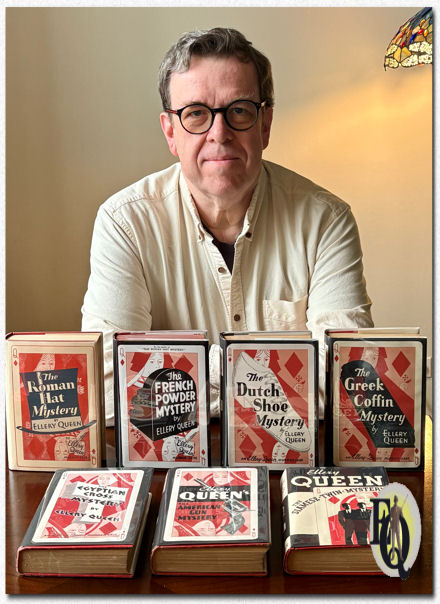 Photo courtesy of James R. Murphy, all rights reserved |
||
|
Notes 1.
Quote from In the
Queens’ Parlor and Other Leaves from the Editors’ Notebook,
Simon & Schuster, 1957. |
||
|
Other articles by this West 87nd
Street Irregular
Page first published on May 15. 2026
|
||
|
||
|
| Introduction | Floor Plan | Q.B.I. |
List of Suspects | Whodunit? | Q.E.D. | Kill as directed | New | Copyright Copyright © MCMXCIX-MMXXVI Ellery Queen, a website on deduction. All rights reserved. |