

NAAR PAGINA: 1 • 2 • 3 • 4 • 5 • 6 • 7 • 8 • 9 • 10 • 11 • 12 • 13 |

|
Cathy Akers-Jordan
Al jarenlang een fervent liefhebber van het mysterygenre. Cathy doceert Writing Mysteries (naast andere vakken) aan de University of Michigan-Flint, waar ze actief is als teaching professor en lecturer. Cathy gaat graag naar conferenties voor misdaadauteurs en ontmoet met plezier andere Ellery Queen-fans. Welkom aan deze West 87th Street Irregular! |
 Foto door Iden Ford, met dank aan Cathy Akers-Jordan |


| Spoiler Warning -- To those who may not, as yet, have read the Ellery Queen works mentioned -- there are some minor spoilers contained in this chapter from the essay. While no major spoilers, there are details mentioned from several books that some readers might still consider as such. |
 |
|
ELLERY QUEEN: FORGOTTEN MASTER DETECTIVE: The Inconsistent Queen |
||
|
It is not unusual for an author who writes a series to make
mistakes or misremember details from novel to novel; a
casual reader would not notice such trivial errors, but
devoted fans spot them instantly. Dannay and Lee were no
exception. Usually their mistakes were trivial, but over
their forty-two year career, they made their share of
obtrusive errors. At other times the authors purposefully
chose to experiment with unusual settings or plot devices.
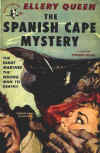
Some of these ventures proved more successful than others. Most of Dannay and Lee’s inconsistencies were of the trivial sort. For instance in The Siamese Twin Mystery, Ellery owned a beautiful, distinctive medieval ring which he used to trap a kleptomaniac. While the ring was useful in this story, it was never mentioned again. This sort of inconsistency is understandable and forgivable; the authors could not be expected to list every item in Ellery’s possession and keep track of such details. Discrepancies in the characters’ habits or knowledge were more obtrusive and disconcerting. For example, in The Spanish Cape Mystery, the victim was found on a patio nude except for an opera cape, and Ellery discussed how difficult it must have been for the killer to strip the body: |
||
 |
“Hmm. It must have been rather a job, at that,’ mused Ellery. ‘Have you ever tried to disrobe an unconscious or sleeping person? I have, and you may take my word for it it’s not as easy as it sounds. There are all manner of arms and legs and things that get in the way. Yes, yes, a job. A job that wouldn’t have been undertaken, especially at such a time, without a definite and utterly essential end in view”. | |
|
Since Ellery did not have
children to dress and care for, the astute reader was likely
to wonder how he knew of the difficulty of disrobing an
unconscious
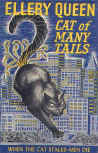
or sleeping person. Fortunately for his reputation, Ellery seldom made such incriminating comments. Dannay and Lee were unusually inconsistent with the smoking habits of Ellery and Inspector Queen. From his earliest days, Ellery smoked cigarettes, and occasionally a pipe, and the Inspector took snuff. By the 1950s Ellery smoked less and the Inspector had given up snuff. In the later books the authors could not quite decide if the Inspector smoked or not. In There Was an Old Woman the Inspector “…lit a stogie and began to puff on it without relish”; in Cat of Many Tails he “…took one of Ellery’s cigarettes; he never smoked cigarettes”; and in The Player on the Other Side: “‘Oh?’ said his father, slowly reaching for one of Ellery’s cigarettes; he almost never smoked cigarettes”. Perhaps the Inspector himself could not decide if he “never smoked” or “almost never smoked cigarettes,” or perhaps he struggled with the habit, never quite giving it up completely. Ellery was also effected by the authors’ inconsistent details. Although Cat of Many Tails was a well-written and suspenseful story, it contained an unusual number of inconsistencies and blatant errors. Ellery accepted help from relatives of two of the victims and even sent one undercover with the Inspector’s blessing. Although Ellery had relied on information from victims’ families before, he had never allowed them to participate in the actual investigation. It is also unlikely that the police would have agreed to put a private citizen in danger without just cause. Unlike the rest of the books in the series, Cat of Many Tails was not fair to the reader, for the authors withheld an important fact. Ellery himself recalled the detail close to the end of the case; this conversation was not mentioned when the scene took place early in the book: |
||
 |
“Of course! It was Cazalis who had been responsible for the birth of the idea. Ellery recalled it all now. It had come up during that September night in the Richardson apartment, in the first hours of the on-scene investigation of Lenore’s murder. There had been a lull and Ellery found himself in conversation with the psychiatrist. They had talked about Ellery’s fiction and Dr. Cazalis had remarked with a smile that the field of phobias offered Ellery’s craft rich stores of material. On being pressed, Cazalis had mentioned work he himself had done on “ochophobia, and nyctophobia” in relation to the development of “ponophobia”; in fact, Ellery remembered saying, he had read a paper on the subject as at convention in Zurich. And Cazalis had talked for a little about the findings, until they were interrupted by the Inspector and recalled to the sorry business of the night”. | |
| Sergeant Velie was not quite himself in Cat of Many Tails. As fear of the serial killer grew in New York City, Velie sent his wife and daughter out of town to safety. Such an action implied an uncharacteristic lack of faith in Ellery’s ability to catch the Cat: | ||
|
|
“ ‘Sent the wife and kid to my mother-in-law’s for a month.’ ‘To Cincinnati? Is Barbara-Ann—?’ ‘No, Barbsy’s okay. And as far as school is concerned,’ said Sergeant Velie argumentatively, ‘she can catch up any time. She’s got her ma’s brains.’ ‘Oh,’ said Ellery; and they ambled on in silence”. | |
|
The strong, silent sergeant, for whom five
sentences in a row was a long speech, debated with Ellery
for pages, discussing ideas and ways to find the killer. In
the rest of the series, Velie admired Ellery and considered
him the “Maestro,” the master detective. For Velie to debate
with Ellery on equal terms, especially at such length, was
completely out of character; Velie spoke more in this one
book than he did in the whole series. Despite his talkative demeanor in Cat of Many Tails, Velie was usually portrayed as smart and quiet. In the short story "Cold Money", he was unusually stupid: |
||
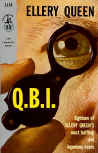 |
“[Inspector:] ‘Velie, get some used towels from the bathroom. Maybe we can sop up enough of this wet ink to make out what Mullane was writing!’ ‘No used towels in here,’ called the Sergeant from the bathroom. ‘Then get some clean ones, you dimwit!’ (Q.B.I.)” . | |
|
The
most glaring discrepancies occur in the flashback novel The
Finishing Stroke, which was written in 1958 but set in the
late 1920s. Since the novel was set twenty years in the
past, it is understandable that Dannay and Lee might make
some mistakes, but it is surprising such blatant errors
slipped past both authors and their editor. For example, in
the earliest books Ellery referred to his old Duesenberg as
“faithful Rosinate;” in later books he called it “old Duesey.”
In The Finishing Stroke Dannay and Lee anachronistically
referred to the car as “old Duesey.” Likewise, Sergeant
Velie did not start calling Ellery “Maestro” until 1939. Yet
in The Finishing Stroke he asked Ellery “How’s the other
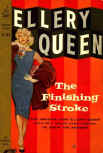
half live, Maestro?”. There is also a discrepancy in the series’ chronology. The Roman Hat Mystery was the first book, written in 1929. Yet The Greek Coffin Mystery, written in 1932, was a flashback to Ellery’s first case. That would make The Roman Hat Mystery his second case, yet in The Finishing Stroke, Dannay and Lee state that it was Ellery’s second case: |
||
 |
“It is no exaggeration to say that as Ellery thrashed in his bed though the interminable night and the rain-gray daylight hours of the following morning, his thoughts were not full of wisdom. He was to encounter and surmount many difficulties in the course of his career: but he was young then, the Case of the Curious Christmas Packages was only his second investigation—really his first independent one—and it seemed to him the end of the world had come”. | |
| The Player on the Other Side, written in 1963, also contained some unusual inconsistencies. It described the unpleasant side of police work in great detail. Most of the Ellery Queen novels fit the traditional model of the detective story. That is, the crime takes place off-stage. Solving the problem, not witnessing the violence is the focus of the novel, so detailed descriptions of inner-city crime were very out of place. Considering that the Inspector had to deal with such grim reality on a daily basis, it was not surprising that for this one novel he took up swearing: | ||
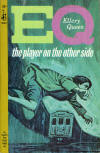 |
“It was Inspector Queen, in the Queen apartment, hanging down the telephone and to his own surprise uttering a word which, when he heard it from the lips of a raided madam, had shocked even him; then running out clutching hat and coat to meet the squad car he could already hear wailing”. | |
|
Another variance in Player was Ellery’s unusual
approach to finding the information he needed to solve the
crime. Instead of relying on logical deduction, Ellery
relied on bluffing: “Thought Ellery: The prod, the goad, the
phrase that gigs, is; [sic] I know all about it”.
Ellery approached each of the suspects and confronted them
with this bluff, hoping for a confession. Such trial
and-error tactics were disappointing and below the Maestro’s
dignity. Dannay and Lee experimented with other elements of the stories as well. The four novels they wrote between 1937 and 1939 (The Door Between, The Devil to Pay, The Four of Hearts and The Dragon’s Teeth) were set in Hollywood, reflecting their stint as screenwriters. Dannay and Lee were trying to reach two new markets: Hollywood and the new, glossy women’s magazines. Because they were striving to write something which could easily be adapted to the screen or serialized in a magazine for female readers, the authors changed their focus from deduction to physical action and romance. On the whole, the books were unsatisfying. In Royal Bloodline: Ellery Queen, Author and Detective, Francis Nevins  described The Devil to Pay, but the description is
applicable to all the “Hollywood Novels”: described The Devil to Pay, but the description is
applicable to all the “Hollywood Novels”: |
||
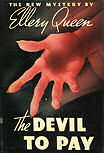 |
“The plot is nowhere near Queen’s best and nowhere near complex enough for a Queen novel, although it’s competent and adequate in most respects. The characterization and dialogue, however, are somewhat less than adequate. Even Ellery becomes no more than a mold for a B-picture leading man; change his name to Charlie Brown and, except for the denouement scene, you’d never know he was supposed to be the detective of Queen’s earlier novels”. | |
|
Nevins’ description is sadly accurate.
Ellery was portrayed as an emotional, occasionally comical,
leading man who relied on guess-work instead of deduction.
For example, in The Door Between while discussing the case
with Doc. Prouty, Ellery suddenly, for no apparent reason,
suspected poison: |
||
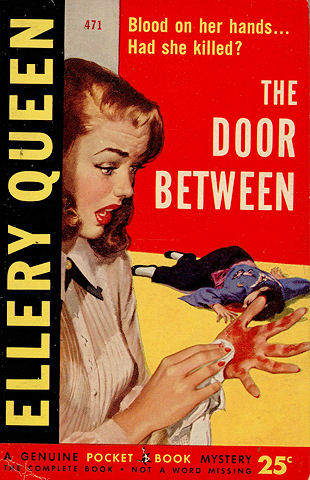 |
“Ellery ran over to him and gripped his
lapel. ‘Prouty, stop babbling before I throttle you! If the
half-scissors didn’t kill her, what did?’ ‘A different… If you’ll give me a chance—’ Ellery smacked his father’s desk. ‘Don’t tell me the knife wound was inflicted over a first wound, a smaller wound—to obliterate it!’ The black jaw [Prouty’s], which needed a shave badly, dropped. ‘Lord! I never dreamed… Is there any way of telling, Prouty? Is the venom recognizable?’ ‘Venom?’ repeated Dr. Prouty dazedly. ‘It was just yesterday. I’d been thinking over the case—its curious angles. I got to thinking about Kinumé.’ Ellery was exultant. ‘And then I remembered Karen Leith’s remarking in the spring that the old Japanese woman came from the Loo-choo Islands. I promptly referred to Britannica and found—pure hunch, mind you!—that a majority of the islands, especially a place called Amami-Oshima, are infested with a genus if venomous reptile called habu.’ ‘Ha—what?’ said Prouty, goggling at him. ‘Trimersurus—I hope that I’ve remembered it correctly. No rattle, scaly head, attain a length of six to seven feet, and their bite causes quick death.’ Ellery drew a deep breath. ‘It was the marks of fangs underneath, Prouty?’ Prouty took the dangling cigar out of his mouth. ‘What’s the matter with him, Q. [Inspector Queen]—is he crazy?’ Ellery’s smile vanished. ‘You mean it wasn’t a snake?’ ‘No!’ ‘But I thought—’ began Ellery feebly. ‘And who said anything about a knife-wound obliterating a another, smaller wound underneath?’ ‘But when I asked you—’ Prouty threw his hands up. ‘Look, Q. Put in a call to Matteawan, and then bring out the half-scissors’ ”. |
|
| Other poor plot devices included Ellery taking up ju-jitsu and altering his appearance by growing a beard and changing his hair style. Worst of all was his attempt to go undercover as a flashy newspaper reporter: | ||
|
|
“The apparition
was a tall lean young man with a clean shaven face and
features just a trifle too sharp to be handsome. The young
man was attired in shapeless slacks of a dingy grey [sic]
hue and the loudest sportscoat Fitzgerald, who had seen
everything, had ever laid eyes on. It was a sort of
disappointing terra cotta, with wide cobalt stripe slashing
through an assortment of brown plaid checks. His shoes were
yellow brogues. His red-and-blue plaid socks curled around
his ankles. On his head he wore a tan felt hat with the fore
part of the brim sticking straight up in the air. And his
eyes were covered by blue-tinted sun-glasses. ‘Hilary “Scoop” King, the demon of the city-room,’ said the apparition, leering. ‘Hazit, Fitz?’ ‘Oh, my God,’ groaned Fitz, hastily shutting the door. ‘...your own father wouldn’t know you in that get-up’ ”(Devil to Pay). |
|
| Ellery not only insisted he be the one to reveal the killer, which was uncharacteristically vain of him, but he later bragged about it: | ||
 |
“ ‘Remember the Ohippi case? I had something to do with solving it, and this—’ he opened his hand— ‘is a token of your pueblo’s gratitude, up to and including Glücke [the police inspector Ellery worked with in Hollywood], poor devil. Honorary Deputy Commissioner’s badge. Look tough, you two, and keep your mouths shut’ ” (Four of Hearts). | |
|
Dannay
and Lee’s Hollywood period was mercifully short. Their
attempt at screenwriting produced none of the desired
results: the cousins worked on numerous screenplays but
received no on-screen credit and only a few Ellery Queen
movies were made. The novels did not adapt well to the big
screen, and the plots bore little resemblance to the
original stories.
Francis Nevins asked Frederick Dannay
about the movies while writing Royal Bloodline: “Dannay and
Lee had nothing whatever to do with any aspect of these
films, and Dannay told me that if he is watching TV in bed
at night and a Queen movie comes on, he ducks under the
covers”. Fortunately for Dannay and Lee their other attempts at unusual settings were more successful. They loved to play with settings which Dannay described as “Ellery in Wonderland”. “The technique rests on plunging the quintessential man of reason into a milieu as mad as the underside of Carroll’s rabbit-hole and requiring him to forge some sort of order out of the chaos”. These stories included the novels There Was an Old Woman and Double, Double, and the short story "The Mad Tea Party". The latter was Dannay’s favorite of the Queen short stories and was the only story by the original authors used in the 1976 television series starring Jim Hutton and David Wayne. There Was an Old Woman revolved around the eccentric Potts family. Cornelia Potts, the matriarch, was head of the world’s largest shoe franchise. Of her six children, three were unusually eccentric: one son, Horatio, lived in a “gingerbread” cottage on his mother’s estate and wrote children’s stories; the other son, Thurlow, was extremely sensitive about his unusual family and spent his time filing lawsuits against anyone who made derogatory remarks about the family; the oldest daughter, Louella, was a scientist who spent her time working on a formula for plastic in order to create a shoe that would put the Potts family out of business. After the court dismissed one of his frivolous lawsuits, Thurston vowed to avenge future insults to the family personally. At that point, the family lawyer hired Ellery to prevent Thurlow from killing anyone. Ellery was unable to prevent a murder, but his attempt to control the chaos of the Potts household was entertaining, although perhaps not to the taste of all readers. As Nevins summarized it:
|
||
 |
“As a result, There Was an Old Woman must ultimately be judged a fascinating two-books-in-one, at odds with itself at every step, with some fine individual sequences in both the novel-of-the-Absurd and the detective-story sections, but never adding up to an integrated whole. To cite an apt phrase in the novel itself, it’s ‘too rich a mixture of sense and nonsense, a mixture too thoroughly mixed’ ”(Royal Bloodline). | |
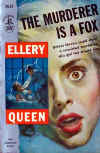
| Double, Double likewise contained bizarre, fairy-tale elements; the plot centered around a series of murders which followed the children’s rhyme “Rich man, poor-man/beggar-man, thief.” The killer, disturbed by his war-time killing in World War II (like Davy Fox in The Murderer is a Fox) noticed a pattern in two local deaths: | ||
 |
‘And then Winship [the killer] got one
of the most diabolical inspirations in the history of
murder. There had been two deaths in Wrightsville recently
which involved and affected Sebastian Dodd [the local
doctor]: the death of Old Luke MacCaby from heart disease
and the suicide of John Spencer Hart. Winship noticed that
MacCaby, always considered a pauper, died a rich man, and
Hart, always considered one of the town’s nabobs, died a
poor man. The contrast stuck him. Rich man-poor man.
Rich
man-poor man. ‘Into Ken’s brain, sharpened by acquisitiveness, sickened by his war experiences—Dakin [the police chief] told me Winship went to pieces when he got back from overseas—into Ken’s mind leaped the old children’s jingle. ‘Immediately,’ said Ellery, ‘immediately Ken saw his implementation whole. Rich man, poor man, beggar man, thief—and then doctor. If the death of MacCaby, who had willed his fortune to Dodd, and the death of Hart, which left Dodd in sole possession of the great Wrightsville Dye Works, should be followed by the deaths of a ‘beggar’ and a ‘thief,’ two people with whom Dodd also had a connection, and if that sinister progression were to be brought forcefully to Dodd’s notice, then Dodd would be convinced of two things: first, that a doctor would certainly be the next to die, and second, that he, Dodd, would certainly be that doctor. And if Dodd were so convinced, he would make a will’. |
|
| Ken Winship set himself up as the doctor’s only heir, then killed him. Caught by the rhyme, his disturbed mind was unable to stop killing, even when there was nothing to be gained. Instead of controlling events, he felt compelled to complete the rhyme and keep killing. Ellery recognized the pattern and was able to stop the murderer. | ||
|
|
‘You know,’ said Ellery, ‘every once in a while I’m caught up short. There’s no explaining some things in feet, minutes, or pounds. There are times when nature, fiddled with, cracks down with a sort of cynical intelligence. Determinism seems proved and fate seems to work in a dark humor. What Hardy called satires of circumstance. Certainly Kenneth Winship must have found himself in the grip of a force beyond his grasp. He brought a certain pattern of events into being. When he tried to stop, by a tremendous force of irony, he found he couldn’t’. | |
|
"The Mad Tea
Party"
similarly revolved around a fairy-tale theme. In it
Ellery attended a houseparty which featured a private
performance of Lewis Carroll’s Alice in Wonderland. After
the host disappeared, Ellery received a series of
packages/clues based on Alice (shoes, cabbages, and chess
pieces). In the end Ellery tricked the killer into
confessing via use of a “corpse” that appeared to return
from the grave. This trite tactic, scoffed at by Ellery in
The Chinese Orange Mystery, is oddly fitting in the
fairy-tale setting and did not seem out of place. Dannay and
Lee were simply enjoying the bizarre atmosphere and
experimenting with how much they could manipulate the
environment and still have a good detective story. Although
they used this approach in only three stories, it was
successful and refreshing. Another area with which Dannay and Lee experimented over the years was Ellery’s relationships with women. Ellery was attractive to women, and obviously found them attractive as well, but he never had a serious long-term relationship. He had some sort of liaison with Paula Paris which lasted several years and a playful relationship with his secretary Nikki Porter, based on mutual attraction, but (except for the Hollywood novels) Dannay and Lee did not forget the purpose of the Ellery Queen series was murder. As Ellery told his friend Beau Rummell in The Dragon’s Teeth, “My specialty is murder, not romance”. Ellery appreciated beautiful, intelligent women, and they likewise found him attractive. His encounter with Marian French in The French Powder Mystery is typical: |
||
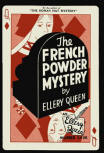 |
“They looked at each other for a startled moment. Ellery saw a slender girl with smoky hair and deep grey [sic] eyes. There was an unaccented cleanliness about the lines of her young body that made him feel pleased for Weaver’s sake. She gave the impression of straightforwardness and strength of will—honest eyes, firm lips, small strong hands, a pleasingly cleft chin and a good straight nose. Ellery smiled. Marion saw a tall athletic man with a suggestion of nascent vigor, startlingly intellectual about the forehead and lips, cool and quiet and composed. He looked thirty, but was younger. There was a hint of Bond Street about his clothes. His long thin fingers clasped a little book and regarded her out of pince-nez eyeglasses.... Then she blushed slightly and her eyes wavered away toward the Inspector”. | |
| Ellery was always a gentleman and behaved accordingly towards women. In The Greek Coffin Mystery he overheard secretary Joan Brett crying, but allowed her her privacy, knowing it had to do with a personal matter. In Halfway House Ellery displayed his manners by looking a young lady in the eye, instead of staring down her low-cut evening gown: | ||
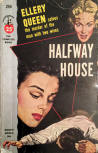 |
“ ‘Good evening,’ said Andrea. She had gone strangely pale at the sight of him. Her black low-cut evening gown with its daring lines might have caused another young man to stare with admiration; but Ellery was what he was, and he chose to study her eyes instead. They were wide with fear”. | |
| Despite his usually courteous behavior, Ellery occasionally gave in to his sense of the mischievous. In Halfway House, he enjoyed putting Bill and Andrea, who were obviously attracted to each other, in an intimate situation: | ||
|
|
“Ellery stared at her. Then he said lightly: ‘My car’s a
two seater, you know. Rumbleseat’s working, though,
if you—’ ‘I’ll sit in the rumbleseat,’ said Bill thickly. ‘I’m sure,’ said Andrea, ‘we can all three sit…’ ‘Would you rather sit on Bill’s lap or mine?’ ‘I’ll drive,’ said Bill. ‘Not you,’ said Ellery. ‘Nobody drives this car but Dr. Queen. I’m afraid you’re stuck Andrea. I’ve been told by habitués that Bill’s is the most uncomfortable lap in the world.’ Bill strode off; his back was stiff. And Andrea plucked at her hair and said softly, ‘I’ll take a chance.’ Ellery drove off with a negligent air, whistling. Bill sat like a lump beside him, his hands at his sides. Andrea was very quiet on Bill’s lap. There was no conversation; only occasionally Andrea murmured a direction to Ellery. The car bounced around rather more than seemed necessary; for some reason Ellery seemed unable to resist the smallest bump in the road”. |
|
| When Ellery met Paula Paris, he uncharacteristically fell in love at first sight: | ||
|
|
“And
Mr. Queen said to himself that Paula Paris was beyond
reasonable doubt the most beautiful woman he had yet met in
Hollywood. No, in the world, ever, anywhere. Now, Mr. Queen had always considered himself immune to the grand passion; even the most attractive of her sex had never meant more to him than some one to open doors for or help in and out of taxis. But at this historic moment misogyny, that crusted armor, inexplicably cracked and fell away from him, leaving him defenseless to the delicate blade. He tried confusedly to clothe himself again in the garments of observation and analysis. There was a nose—a nose, yes and a mouth, a white skin… yes, yes, very white, and two eyes—what could one say about them?—an interesting straight line of gray in her black-lacquer hair… all to be sure, to be sure. He was conscious, too, of a garment—was it a Lanvin, a Patou, or a Poirot?—no, that was a little Belgian detective—a design in the silk gown; yes, yes, a design, and a bodice, and a softly falling skirt that dropped from the knee in long, pure, Praxielean lines, and an aroma, or rather an effluvium, emanating from her person that was like the ghost of last year’s honeysuckle… Mr. Queen uttered a hollow inward chuckle. Honeysuckle! Damn analysis. This was a woman. No—Woman, without the procrusteanizing article. Or… was . . . it… the Woman? ‘Here, here,’ said Mr. Queen in a panic, and almost aloud. ‘Stop that, you damned fool’ ” (Four of Hearts). |
|
| Other than Paula Paris and Nikki Porter, Ellery was not romantically involved with any of the women he met. His playful mood, hokey accent and the strong sexual overtones he evinced in The Origin of Evil were very out of character: | ||
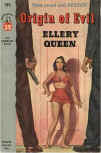 |
“ ‘Beagle.’ Ellery glared. ‘Beagle… Of course. Of
course. No other possibility. If I’d had the brain of a wood
louse… Beagle, Laurel, beagle!’ And he swept her off her
feet and planted five kisses on the top of her wet head.
Then he tossed her on the unmade bed and before her
horrified eyes went into a fast tap—an accomplishment which
was one of his most sacred secrets, unknown even to his
father. And Ellery chanted, ‘Merci, mu pretty one, my
she-detective. You have follow ze clue of se ar-sen-ique, of
ze little frog, of ze wallette, of ze eversing bu ze sing
you know all ze time—zat is to say, ze beagle. Oh, ze
beagle!’ And he changed to a softshoe. ‘But what’s the breed of dog got to do with anything, Ellery?’ moaned Laurel. ‘The only connection I can see with the word ‘beagle’ is its slang meaning. Isn’t ‘beagle’ a detective?’ ‘Ironic, isn’t it?’ chortled Ellery; and he exited doing a Shuffle-Off-to-Buffalo, blowing farewell kisses and almost breaking the prominent nose of Mrs. Monk, Laurel’s housekeeper, who had it pressed in absolute terror to the bedroom door”. |
|
| Fortunately for Ellery’s dignity, Dannay and Lee usually avoided such silly behavior. Afterwards, Ellery was only half joking in his declaration of attraction to unavailable women, such as Sally Van Horn in Ten Days’ Wonder: | ||
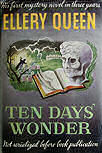 |
“
‘Of course,’ Ellery went on, ‘you can keep on
calling me Mr. Queen, but I’m going to tell your husband the
very first thing that I’ve fallen in love with you. Yes! And
then I’m going to bury myself in that guest house Howard
waved before my nose and work like mad substituting
literature for life… What were you about to say, Sally?’ He wondered as he grinned at her which nerve he had touched. She was thoroughly upset; he thought for a silly moment that she was going to burst into tears. ‘I’m sorry, Mrs. Van Horn,’ said Ellery, touching her hand. ‘I’m really sorry. Forgive me.’ ‘Don’t you dare,’ said Sally in an angry voice. ‘It’s just me. I’ve got an inferiority complex a mile long. And you’re very clever’—Sally hesitated, then she laughed—’Ellery’ ” (Ten Days). |
|
| Dannay and Lee could never quite decide how Ellery should deal with sexual temptation. In Cat of Many Tails he used humor when he found Celeste, sister of the victim and his temporary assistant, asleep in his bed, naked: | ||
|
|
“Ellery found himself sitting on the edge of
the bed; the back of his neck throbbed again. ‘I’ve often
dreamed about this situation,’ he said, rubbing it. ‘What?’ said Celeste sleepily. ‘Is it still today?’ Her black hair coursed over his pillow in sweet poetic dreams. ‘But exhaustion,’ Ellery explained ‘is the enemy of poetry’ ”. |
|
| Ellery was not above feeling lonely. When Ken and Rima were married in Double, Double, Ellery was wistful; he had genuinely been attracted to Rima. The bride and groom encouraged him to attend their wedding reception: | ||
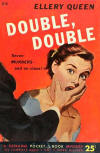 |
“ ‘Not this time,’ Mr. Queen said hollowly. ‘There’s a limit to every man’s endurance, and this marks mine. You two go on about your business and let me get quietly potted’ ”. | |
|
Despite
the hints in the introduction to The Roman Hat Mystery,
Ellery never married. Like his father, and all good
detectives, he was destined to avoid romance. The last area where Dannay and Lee were blatantly inconsistent was Nikki Porter’s background. Nikki first appeared on the Ellery Queen radio show; Dannay and Lee hoped she would attract a female audience (Nevins
Royal Bloodline 83). Nikki Porter
“was a professional typist to whom Ellery had been taking
his near-illegible manuscripts until she decided to do them
both a favor by asking for a full-time job as his secretary
so that he could dictate to her instead of scribbling”
(Nevins
Sound of Detection).Dannay and Lee appeared to have trouble deciding on Nikki’s origin, however; it kept changing as the series progressed. This was partially because Calendar of Crime (1952), a collection of short stories based on the first radio show, was published after Nikki’s first appearance in print in There Was an Old Woman (1943). Readers who were not old enough to remember the radio show might have been confused. In the novel There Was an Old Woman 1 Ellery and Sheila Potts were strongly attracted to one another; after the murders Sheila wanted to avoid association with her family name so Ellery offered her a job as his secretary. She agreed to change her name and go to secretarial school. Ellery suggested the name Nikki Porter after the heroine in his current novel, 2 and she agreed. This origin, in which Nikki started working for Ellery in 1943, contradicted her origin on the radio show in which she began working as his typist in 1939. In the short story "The Adventure of the Gettysburg Bugle" Nikki had just begun to work for Ellery: |
||
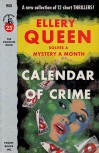 |
“This is a very old story as Queen stories go. It happened in Ellery’s salad days, when he was tossing his talents about like a Sunday chef and a red-headed girl named Nikki Porter had just attached herself to his typewriter. But it has not staled, this story; it has an unwithering flavour [sic] which those who partook of it relish to this day” (Calendar). | |
|
If this story was set in
Ellery’s “salad days,” his youth, Nikki was an anachronism,
since she did not start working for him until 1939 at the
earliest (with the advent of the radio show). Perhaps Dannay
and Lee were trying to update Ellery, to make him younger in
the present setting, and simply overlooked Nikki’s past. In the short story "The Adventure of the Dead Cat", even Nikki’s friends seem to have forgotten her past as Sheila Potts, or at least they did not talk about it: |
||
|
|
“ ‘Ann! Ann Trent!’ Nikki was squealing. ‘Oh, Ann, you fool, however did you find me?’ ‘Nikki, you’re looking wonderful. Oh, but you’re famous darling. The great E. Q.’s secretary…’ ”(Calendar). | |
|
In
The Scarlet Letters Ellery seems to have forgotten that
Nikki was once Sheila Potts and knew her eccentric mother
and sister well. The narrative stated: “It occurred to him
suddenly that Nikki had lost her mother very early and had
never known a sister”. Similarly the comment: “He
remembered Nikki’s remarking once, with the awe of the
budgeted working girl, that Martha had bought a coat at
Jay Thorpe” is also indicative of amnesia on the authors’
part. As the daughter of millionaire Cordelia Potts,
Nikki never had to worry about money and took the job as
Ellery’s secretary and changed her name only to avoid
association with her infamous family. Nikki’s description also changed frequently. On the radio show she was described as a blonde; in the movies she was portrayed by a brunette. In There Was an Old Woman and The Scarlet Letters, Nikki was a redhead. As Francis Nevins summarized it: “We will pass
over in silence the question whether these are mere
oversights or Queen’s [Dannay and Lee’s] way of paying
tribute to the ‘infinite variety’ of woman” (Royal Bloodline).It is easy to forgive Dannay and Lee such trivial changes or errors. Their willingness to experiment with elements in their novels, whether successful or not, kept them interested in writing more Ellery Queen stories. It is also understandable that since they constantly updated the series, to keep the setting always in the present time, mistakes or inconsistencies might creep in as they modified the characters’ past to fit the present. Some reflections of changing current trends, like the attraction of Hollywood during the late 1930s, did not age well. Since Dannay and Lee were among the first popular mystery writers to write a long-running series, they could not have foreseen the complications to which their early choices would lead in Ellery’s future. |
||
|
Chapter 9 Section III "Literary
Themes and Techniques" |
||
|
Notes 2. There was no such novel. The
closest reference was that Nikki was a character in the
story Ellery was writing when he was not reading the Holmes
manuscript in A Study in Terror. Careful readers
would remember Nikki’s origin and would pick up on the hint.
|
||
 Photo by Iden Ford, courtesy of Cathy Akers-Jordan |
||
|
Other articles by this West 87nd
Street Irregular
Page first published on February 22. 2026
|
||
|
||
|
|
| Inleiding | Plattegrond | Q.B.I. | Liist Verdachten | Wie? | Q.E.D.
| Moord en
scene | Nieuw |
Auteursrecht Copyright © MCMXCIX-MMXXVI Ellery Queen, een website rond deductie. Alle rechten voorbehouden. |