
|
|

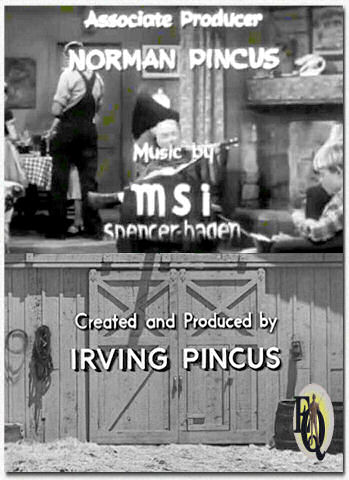

 orman
Pincus
(March 27. 1906
- October 30. 1978) orman
Pincus
(March 27. 1906
- October 30. 1978) |
|
|
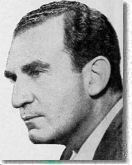
Height: 5' 8" Weight: 150 lbs Eyes: grey Hair: black Marriages: (1) Katherine (Kay) Eleanor Hatfield (Dec 2. 1939, Scarsdale - Jul 16. 1946) (divorced) Son: Charles (b. 1943 - ) (2) Katherine (Kay) Eleanor Hatfield (Oct 2. 1946 - 1954) (divorced) *** (3) Phyllis O. Gehrig (Oct 3. 1958, Clark, Nevada - Oct 30. 1978) (his death) |
 |
 rving
Pincus
(March 14. 1914 - May 13. 1984) ** rving
Pincus
(March 14. 1914 - May 13. 1984) ** |
|
|
Height: 5' 7,5" Weight: 150 lbs Eyes: blue Hair: brown Marriages: (1) Louise Violet Cropper (1944, New York - May 13. 1984 , his death **) Daughter: Laurie Jane (Dec 14. 1951, NYC -), artist-sculptor |
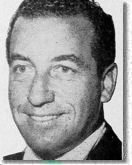 |
| Above right: Norman (top) and Irving (bottom) Pincus. | |
|
The elder of the two brothers, Norman Charles Pincus, was born on March 27. 1906, in Manhattan, New York. His younger brother, Irving Lewis Pincus, was born in the same city on March 14. 1914. Their parents, Charles Pincus and Lena Klein, had immigrated from Germany and Austria, respectively. Both were actors and singers, but Charles was also active in real estate. Together with his brothers, Alexander H. and Louis, he developed the Alvin, Imperial, and Longacre Theatres in Manhattan, the Boulevard Theatre in the Bronx, and the Warwick Theatre in Brooklyn. After graduating from Columbia University, Norman's first job was managing the Alvin Theatre. Under his management, the theater became known as "The House of Hits." In the 1930 U.S. Census, his occupation is listed as a salesman for Warner Movies Films. On November 5. 1932, he became house manager of the Alvin Theatre. Their father Charles Pincus died at his home at 222 West 83rd Street on February 17. 1933, after having been confined there for the previous year with heart disease. After completing just one year of college, Irving began his career as Howard Lindsay's assistant (revised book staging) on Anything Goes (Alvin Theatre, Nov 21. 1934 - Nov 16. 1935)* He later became stage manager of Red, Hot and Blue! (Alvin Theatre, Oct 29. 1936 - Apr 10. 1937), before joining his brother Norman to produce his first play, The Good (Windsor Theatre, Oct 5. - 31. 1938), by Chester Erskine. Their mother, Lena Klein, passed away November 25. 1937 in Brooklyn, Kings, N.Y. As early as 1937, Norman Pincus was reported dating, forming a duo with Jessica Pepper, a Red, Hot and Blue! showgirl (ca Feb 15. 1937), or “not kidding” with Mary Ann O’Brien, a You Never Know chorine by September 1938. However, congratulations were in order when Norman Pincus took Kay Hatfield as his bride in Scarsdale in late 1939. With Joshua Logan, Irving provided the idea for the Rodgers and Hart musical Higher and Higher (Sam S. Schubert Theatre, Apr 4. - . Aug 24. 1940), which later became a Frank Sinatra film in 1943. He also co-authored, with Frank Gabrielson, The More the Merrier (Cort Theatre, Sep 15. -27. 1941), directed by Otto L. Preminger and presented by Otto L. Preminger and Norman Pincus. It was a boisterous three-ring affair featuring a snowstorm in the Rockies, a corpse on roller skates, and an escaped convict, all set against the backdrop of a Colorado millionaire's red-plush castle. Both brothers were working at the Alvin Theatre (250 West 52nd Street) when they registered for the draft on October 16. 1940. Irving, who was unmarried, lived with his parents at 33 Riverside Drive, New York, while Norman was by then married to Katherine (Kay) Eleanor Hatfield and lived at 3 East 66th Street, New York. |
|
|
The Army interrupted Irving's career when he enlisted on January 13. 1942. He spent three years in the Air Corps. As Second Lieutenant Irving Pincus, he served as a bombardier in the U.S. Army Air Forces with the Fifteenth Air Force. During that time, Sgt. Irving Pincus was assistant stage manager for Winged Victory (44th Street Theatre, Nov 20. 1943 - May 20. 1944). Produced by the U.S. Army Air Forces as both a morale booster and a fundraiser for the Army Emergency Relief Fund, it became one of the biggest Broadway hits of the war. In 1944, Irving married Louise Cropper in New York. His combat tour was marked by an extraordinary series of life-threatening incidents during only eleven combat sorties:
Pincus was able to remain on flying status through periodic leaves and psychotherapy. Eventually, however, learning about the fate of two fellow crew members who had experienced many of the same traumatic events convinced him that he had reached his limit. A medical evaluation dated March 29. 1945 diagnosed him with a mild anxiety neurosis resulting from the cumulative psychological effects of combat flying. Pincus's record illustrates the extreme hazards faced by Fifteenth Air Force bomber crews. Surviving a prolonged sea ditching, a mid-air collision, multiple emergency landings, and a crash landing within the space of only eleven sorties was highly unusual. The Army Air Forces concluded that the cumulative psychological impact warranted his removal from combat duty. |
|
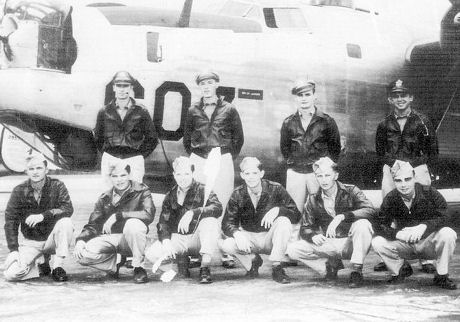 Above: 2nd Lt. Irving Pincus is pictured at the top right. As bombardier, he was a member of the James Pitt crew aboard a B-24 Liberator. The full crew consisted of a pilot, co-pilot, navigator, bombardier, engineer, radio operator, nose turret gunner, and three additional gunners. Gunner Russell E. Whitmore, who was killed during the second sortie, is the fourth man kneeling from the left. (514th Squadron). |
|
|
After the war, Irving returned to civilian life in 1945 and became general manager for Billy Rose's Seven Lively Arts. He also began writing for radio. He co-authored Father, Dear Father, an original story that was sold to The Ford Radio Hour (Dec 2. 1947) and later adapted for television as an episode of The Magnavox Theater (CBS, Nov 10. 1950). By the time Norman and Irving entered radio and television as package producers, they already had deep roots in the legitimate theater. For a generation, their family had owned and operated the celebrated Longacre, Imperial, and Alvin Theatres in New York. When the family sold the Alvin Theatre, Norman and Irving turned their talents to television. Prior to 1948, the brothers sold their interest in the Alvin Theatre to CBS and invested part of the proceeds in packaging television programs. Together with Worthington Miner, the Pincus brothers produced Mr. I. Magination (CBS, May 29. 1949 - Jun 28. 1952), an award-winning children's television series. Each week, the host, Mr. I. Magination (Paul Tripp), dressed as a train engineer, welcomed a group of children, with the same young performers appearing on a rotating basis. Two children were selected to ask about a particular career, occupation, hobby, or other topic of interest. Mr. I. Magination would then play his "magic" slide flute, and together they would board a train bound for Imagination Land, where they met professionals representing each of the two featured subjects for that week's program. |
|
|
Irving's first television directing assignments came in 1950 and 1951, when he directed two episodes of the original DuMont network version of The Adventures of Ellery Queen which was produced by Norman and Irving Pincus. The phrase most often used by filmmakers when confronted with Lee and Dannay's brilliant but prickly detective seemed to be, "No one likes a know-it-all." As a result, Ellery remained simply a likable, intelligent young man on the big screen. The film series ended in 1942, but the radio series continued into the late 1940s, when television was ready to take over. Lee worked with critic and author Anthony Boucher on the radio series, while Dannay devoted himself to making Ellery Queen's Mystery Magazine the premier publication in the mystery genre. Both sought to deepen Ellery's character. They were not satisfied with merely constructing ingenious mystery puzzles; they wanted their murders to carry a deeper sociological meaning. This guilt-ridden Ellery did not seem to be an ideal subject for live television mysteries. He was too clever, too unconventional, some might even say too tortured, to become a welcome guest in millions of homes. That did not stop the Pincus brothers. What they focused on was not the literary character himself, but his fame. They saw a star who had already succeeded in every medium, with an unmistakably memorable name. Undaunted by the challenge of creating a new whodunit for Ellery to solve in just thirty minutes each week, they brought Queen to television. They hired Eugene Burr as story editor, Donald Richardson as director, and the unassuming Richard Hart for the title role. The program won the TV Guide Award for Best Television Mystery of 1950 and remained on the air until 1952. If you think watching Ellery Queen is hard on the nerves, try producing it. At first the series was broadcast live. But after a warehouse fire destroyed the scenery, the leading lady lost her voice during a live broadcast, an actor walked into the climactic scene wearing squeaky shoes, and the leading man dropped dead, the Pincus brothers had had enough. "From now on," Norman announced, in a small and shaken voice, "we're gonna film this show!" (TV Guide, Dec 4. 1954). A brief article in Broadcasting (Mar 2. 1953) reported that the producers of the Ellery Queen television series, "until recently broadcast live on ABC-TV from New York," were in Hollywood to produce a pilot film for a filmed version of the series at Hal Roach Studios in Culver City, with Hugh Marlowe in the title role. The Adventures of Ellery Queen, also known as Mystery Is My Business (TPA), starring Hugh Marlowe, Florenz Ames, and Charlotte Keane, ran from 1954-1956. |
|
Their next television venture was to be in the dramatic field when they reached an exclusive agreement with the Authors' League Theatre (also known as the Authors' League of America) to produce a dramatic anthology series featuring works by leading authors and composers (1952). The proposed series, titled Theatre of America, was backed by exclusive agreements the Pincus brothers had negotiated with Ernest Hemingway, Noël Coward, Gian Carlo Menotti, Eric Ambler, and others. Norman and Irving had very different temperaments, yet they complemented each other perfectly in their organization. Norman handled production, casting, and the business side of the operation, while Irving directed the creative end, overseeing scripts and developing ideas for new television packages. Together they maintained a complete production organization that handled every aspect of their programs, including scenic design and construction. Norman's hobbies were tennis and photography. Irving enjoyed painting in oils and was also an avid art collector, assembling a valuable collection of paintings. |
| The brothers could also be tough businessmen. The season opener of General Electric Summer Originals ("It's Sunny Again", Jul 3. 1956) was produced by the Pincus brothers and directed by Don Weis. It starred Vivian Blaine, who had agreed to appear in the 26-episode series, with work beginning on the production of the pilot. However, after the Pincus brothers had already invested $75,000 in the project, she refused to fulfill her contract. Blaine and her husband, theatrical agent Manny G. Frank, were subsequently sued for $375,000 in damages for her alleged failure to appear in the series of television films. |
|
Irving and Norman created and produced The Real McCoys for ABC television, helping spark a wider interest in rural Americana. They proposed the concept to the networks in the mid-1950s, and the series, starring Walter Brennan as a West Virginia mountain man who moves his family to a ranch in California, went on the air in October 1957. It ran for eight seasons until 1963 and continued in reruns for many years thereafter. Irving married Louise Violet Cropper, and their daughter Laurie, born December 14. 1951 in New York City, later recalled that her father took his work very seriously: “If I wasn’t watching it, I was at the (studio) set with my father, watching it coming to life.” At times she would see Walter Brennan portraying his character on the series one day, and the next Brennan would visit the Pincus home for dinner. Irving Pincus joined series star Walter Brennan in forming Brennan-Westgate Productions, with filming taking place at Desilu Studios. Pincus produced ninety-one episodes from 1957 to 1961 and wrote scripts for eighty-five segments throughout the run of the program, from the third episode, The Egg War" to the series finale "Pepino's Mama." |
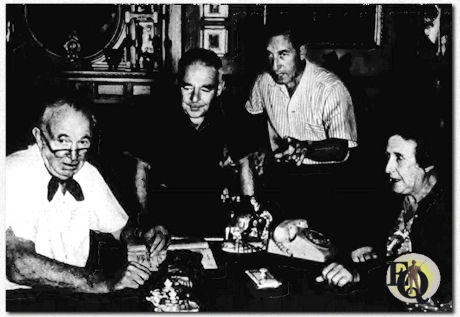 Above: Producer Irving Pincus (pointing) and director Charles Barton rehearse Walter Brennan and guest star Minerva Urecal during The Real McCoys episode "The Gigolo" (Nov 10. 1960). In the episode, Amos, hoping to avoid foreclosure, courts the elderly spinster who holds the mortgage on the McCoy farm. (The Washington Post, Dec 4. 1960) |
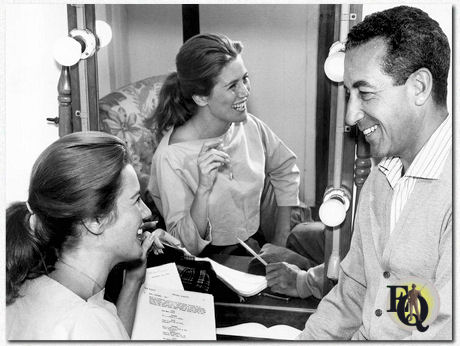 Above: Actor Kathleen Nolan and producer Irving Pincus for The Real McCoys in dressing room (ca. 1960), 1957-63 Courtesy Everett Collection |
|
Kathleen Nolan, a member of the cast of The Real McCoys, recalled how the Pincus brothers discovered singer and bandleader Tony Martinez, a Puerto Rican native selected to play the Mexican farmhand Pepino Garcia. Martinez was performing at a club in Hollywood, California, which the Pincuses visited. Nolan, who played housewife Kate McCoy during the first five years of the series, said that Martinez initially failed to respond to the Pincus brothers because he assumed their interest was a joke. The producers, however, persisted and ultimately signed him to the cast. Nolan, who later served as president of the Screen Actors Guild from 1975–1980, described Martinez’s casting as Pepino as “a major breakthrough in terms of minority representation on television. It may not have been the representation that we are seeking now, but it certainly was a breakthrough to have a major character on television that was not white…” |
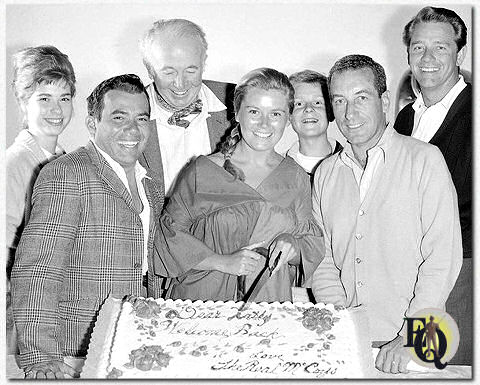 Above: Irving Pincus with the cast of The Real McCoys (L-R) Lydia Reed, Tony Martinez, Walter Brennan, Kathleen Nolan, Michael Winkelman, Irving Pincus and Richard Crenna (ABC Photo Archives, Oct 1. 1960) |
|
On October 3. 1958, Norman Pincus married actress and costume designer Phyllis Gehrig, who had previously been married to comedian Alan Sues. In September 1967, CBS signed Irving Pincus to produce Phil Silvers’ new series. This half-hour comedy was to star Silvers as a Bel Air patrolman. Negotiations began with Larry Gelbart (who later wrote the hit television series M*A*S*H) to write the pilot, but the proposed sitcom, titled Bel Air Patrol (or Eddie), was shelved for four years. It eventually aired as a one-time special in 1971 but failed to launch as a weekly series. After The Real McCoys, Irving Pincus did not produce again until the feature film To Find a Man (Columbia, Jan 20. 1972), starring Pamela Sue Martin. Norman Pincus died “after a long illness” on October 30. 1978 in West Hollywood, California. It is unclear how Irving spent much of the remainder of his life from 1963 until he became ill in November 1983. He died of cancer at the age of 70 on May 13. 1984** in Los Angeles, California (Santa Monica Hospital). His ashes were scattered over the Pacific Ocean following a memorial service on May 17. |
|
Notes: * He also played a bell boy and was stage manager for the production. ** Multiple newspaper obituaries say May 14. as do some genealogical sites. *** The 1940 Census lists them as couple, the 1950 census lists Katharine as divorced and Norman, divorced, living with his 7 year old son Charles. 8 months after their first divorce the couple remarried. Katharine who later remarried Burton Kamke passed away in 2006. All dates for movies are for the first US release. All dates for TV programs are original first airdates. All dates for (radio) plays are for the time span the person was involved. Facts, programs or dates in red still need confirmation. |
Click on Uncle Sam if you think you can help out...!
 |
|
Other references
Additional video & audio
sources |
|
This profile is a part of
Ellery Queen a website on deduction.
The persons above either wrote, produced or directed episodes
of the DuMont
Ellery Queen TV series.
Click Uncle Sam if you think you can help
out...! Many of the profiles on this site have been compiled after very careful research of various sources. Please quote and cite ethically! |
|
Page first published July 5. 2026 Version 1.0 Last updated July 5. 2026 |
b
a c k
t o L i s t o f S u s p
e c t s
|
|
Introduction | Floor Plan | Q.B.I. |
List of Suspects | Whodunit? | Q.E.D. | Kill as directed | New | Copyright  Copyright © MCMXCIX-MMXXVI Ellery Queen, a website on deduction. All rights reserved. |